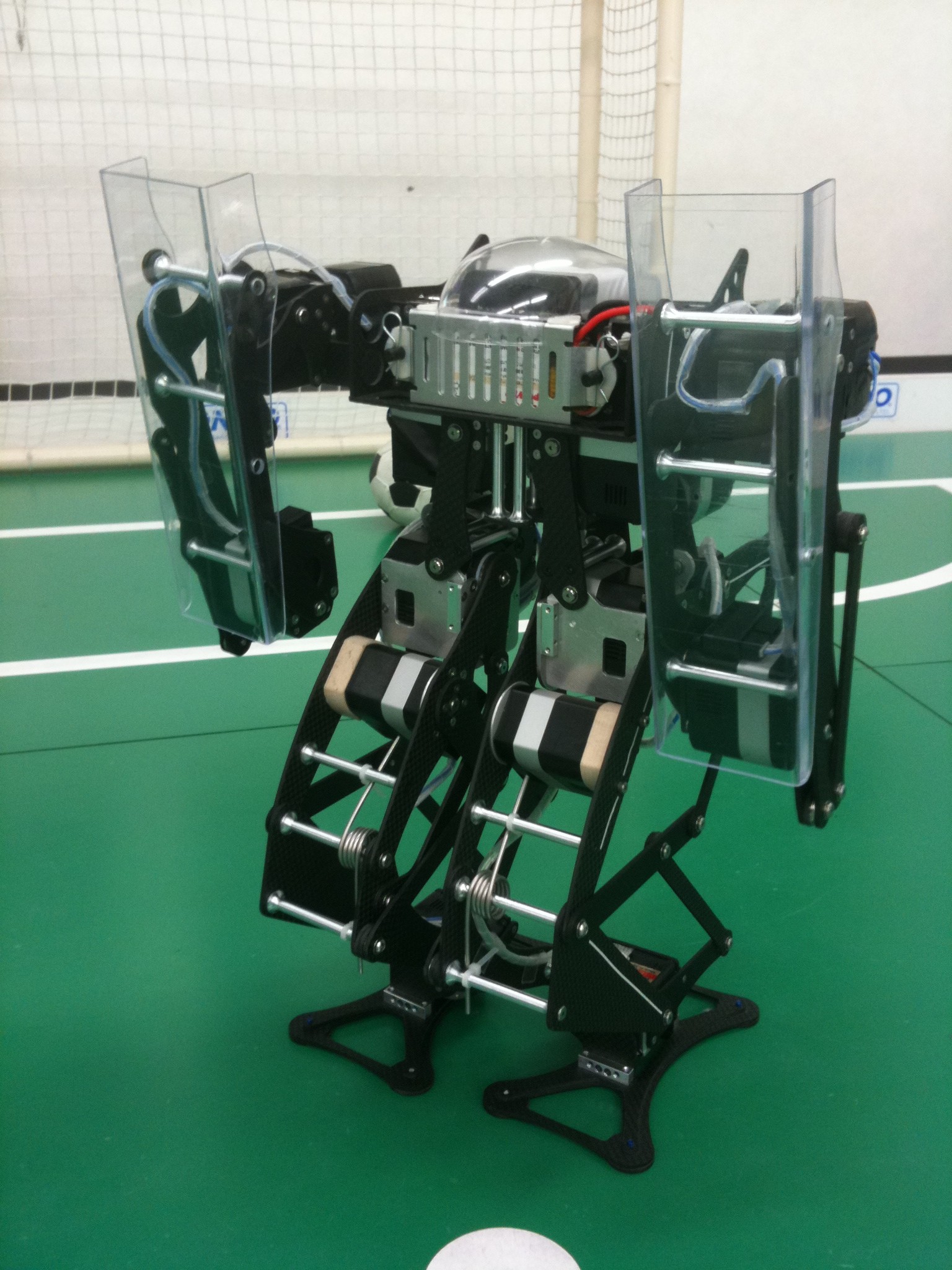
Lem Fugitt at Robots-Dreams has posted a great video from one of the preliminary qualifiers, in which each robot has to run a several-meter course as quickly as possible. The winner this year, by a substantial margin, is a new robot called Frosty. In the video below, Lem explains about this impressive robot.
A new video shows a cool behavior you can download to your NAO robot from the RobotAppStore:
 The European Commission has announced funding for the Human Brain Project, a massive simulation project whose goal is no less than the detailed simulation of a complete human brain. The project, expected to last 10 years and cost over 1.2 billion euros (1.6 billion dollars), will be coordinated at the Ecole Polytechnique Fédérale de Lausanne (EPFL) in Switzerland. It’s the maturation of the Blue Brain Project, which for the last ten years has been striving to simulate a small section of rat neocortex, with some very interesting results.
The official EPFL press release includes a decent introduction to the project, along with a 7-minute overview video, which you can also watch below.
The Music Entertainment Lab (MET-lab) at Drexel University has posted a neat little video of a small hobby humanoid playing an electronic keyboard. This is pretty trivial when the robot is in a fixed position relative to the keyboard. But this robot is able to adjust automatically when the keyboard is moved.
 Team DARwIn has posted its qualification video for Robocup 2013. The robot featured is actually DARwIn OP, a slightly tortured acronym for Dynamic Anthropomorphic Robot with Intelligence – Open Platform. It’s an open-source humanoid robot design based on pricey but performant Robotis Dynamixel servos. What’s most impressive is DARwIn’s autonomy: in the video below, you can see it visually locating the ball and the goal posts, getting into position behind the ball, and kicking it through the goal. This is not remote controlled; the robot is doing all that on its own. Read more…

An article in Fast Company presents a nice overview of some recent work at the Cornell Creative Machines Lab on using genetic algorithms to evolve neural networks to control real robots. The genetic algorithm is first run in a simulated environment, and after a few hundred or thousand generations, the resulting neural network is downloaded into a real robot.

 A cute new robot from Tomy was introduced this week at the Tokyo Gift Show. Called the Automee, it’s like a tiny little Roomba that wanders around on your iPad or other tablet or phone, autonomously cleaning the screen. Check out the video from Robots-Dreams:
Robo-One champion robot builder Dr. GIY has been hard at work for the last year or so on a less combative robot wonder.

The new custom-built robot stands half a meter tall, and displays amazing skill both in its construction and in its animation, as you’ll see in the video below.

Here’s a heartwarming story. A little girl named Emma Lavelle was born with a genetic condition that rendered her arms too weak to use. For older sufferers of this disease, there are exoskeleton devices that strap to the arms and shoulders and provide mechanical assistance; but for a small child like Emma, such devices are too big and far too heavy to use.
But when two-year-old Emma’s mother approached the folks at the Center for Orthopedics Research and Development, they made a special, custom version of the Wilmington Robotic Exoskeleton, just for her. They were able to make it light and affordable, because almost all the parts were made on a 3D printer. Read more…


 Bot Scene