
 The “Dekinnoka! 11” Robot Pro Wrestling tournament (ロボットプロレス できんのか!11) will take place in Soka City, Japan on November 3rd. Dekinnoka is an entertaining, more light-hearted humanoid robotics tournament than, say, Robo-One, though it brings out many of the same competitors. Taking some lessons from American pro wrestling, each robot in the tournament is given a complete character, with an impressive-sounding name and backstory, to further engage the audience.
The format and rules of the tournament are simple. Eight robots compete, each starting out with a large machine screw in a jar. Robots face off in pairs; the winner of each bout is the one that knocks its opponent down, or pushes it out of the ring. The winner takes all the loser’s screws. At the end, one robot will end up with all eight screw jars, allowing its builder to invoke Nejiron, God of Screws, for a divine favor.
This boils down to a simple eight-contestant single-elimination tournament, as far as I can tell, but props go to the conference organizers for making even the mechanics fun and entertaining.
I’ll post any photos and videos I can find of the tournament here after it happens. Meanwhile, for more details, see the excellent write-up at Biped Robot News Japan.
 DARPA has posted a couple of new videos showing two predecessors of its Atlas robot — the basis for the reference platform provided in the DARPA Robotics Challenge — overcoming stairs, pits, and other obstacles.
 The Parallella project is developing an open, affordable, low-power, high-performance parallel computing platform. It sounds too good to be true, but Adapteva, the team behind the project, has a history of achieving aggressive engineering goals in exactly this space. Moreover, the supercomputer is based on the existing Epiphany line of chips.
This EE Times article explains it better. They’re planning two versions of the computer; a 16-core (based on the Epiphany E16) version for $100, and a 64-core version (using the Epiphany E64) for $200. The latter would deliver over 90 GFLOPS (90 billion floating-point operations per second), on a board the size of a credit card, while consuming only 5W of power. Read more…
 The DARPA Robotics Challenge (DRC) officially kicked off this week, and what can I say — this is huge.
This is a competition funded by DARPA (the same guys who brought us autonomous cars, the Internet, and many other innovations) to develop full-sized autonomous humanoid robots. As they put it:
The primary goal of the DARPA Robotics Challenge program is to develop ground robotic capabilities to execute complex tasks in dangerous, degraded, human-engineered environments. The program will focus on robots that can use available human tools, ranging from hand tools to vehicles.
The Robot Hall of Fame at Carnegie Mellon Science Center in Pittsburgh inducted four new robots into its ranks last night. More than 17,000 people voted to elect this year’s winners.
 Robots-Dreams has shared an amazing video showing Primer-V4, an amazing biped robot built by Dr. Guero in Japan, walking a tightrope.
This is no smoke & mirrors trick — the robot really is balancing itself, shifting its center of gravity using its arms just like a human tightrope walker.

This week I finally found the time to hook up the Dongbu Robot Herkulex DRS-0101 servo that I picked up last month at the VStone Robot Shop in Tokyo. (If you’re here in the States, you can pick these up from Road Narrows.) After a few missteps, and some fantastic tech support from Dongbu Robot, I got it working. It really isn’t difficult; here’s how to do it, and a few tips I learned in the process.
(Non-disclaimer: I’m going to be gushing a bit about these servos, but I don’t work in any way for Dongbu Robot, VStone, Road Narrows, or anybody else… I’m just a happy customer.)
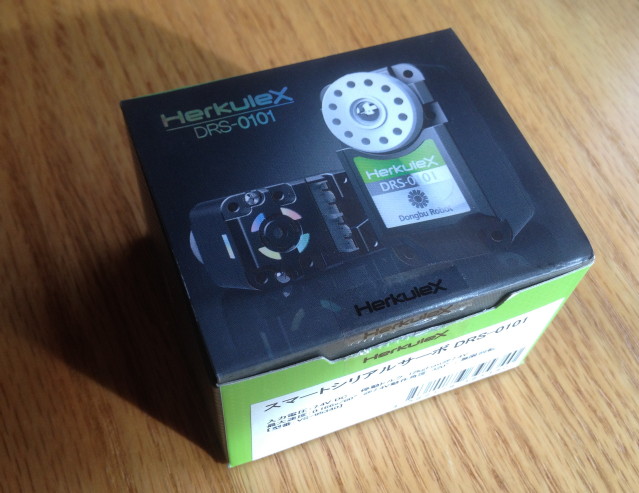
Just imagine the rotational, torquey goodness contained in this cute little box.
I love servos (especially the modern smart kind). They wrap up a motor, a gearbox, a motor controller, a position encoder, and a microcontroller into one neat little package that you just drop into your project and use. But what if, for one reason or another, you can’t use an off-the-shelf servo, but you still need to know how some joint or wheel in your robot is rotated?
 There are lots of fairly low-cost quadrature encoders, that send a series of positions when a sensor disc is rotated. This tells you when the thing is moving, but not where it actually is — for that, you need some sort of “homing” switch at one extreme of the motion, and you have to hit that on start-up, and then count rotation pulses from there. Maybe this is OK for something like a CNC machine, but it’s not likely to work well for, say, a humanoid robot.
What you really want is an absolute position encoder. This is a sensor that tells you exactly what position your disc (or linear mechanism) is in, right now, even when you’ve just powered it up. Unfortunately, these are neither common nor cheap. Industrial models tend to cost upwards of $200. On the low end, pickings are slim; but one could try this through-shaft potentiometer, or this Hall Effect encoder. Each has its pros and cons.
But here’s another approach: make your own encoder, using a couple of cheap analog IR sensors, and a simple grayscale disc or ring. The gradient on the disc encodes the sine and cosine of the angle, and your two sensors are positioned 90 degrees apart. This gives you everything you need to determine the absolute angle.
 Arduino is a great platform, especially for electronics newbies. It has a great cross-platform IDE, libraries for almost everything, and a very active and friendly community. But like almost any other microcontroller, it can’t push a lot of current — if you start running motors off the output pins directly, you’re going to quickly damage any typical Arduino board.
Enter Heatit, a new open-source Arduino compatible board currently doing a Kickstarter. It’s specifically designed to push out large currents — up to half an amp per pin, or 2A total. Moreover, it can precisely control the amount of current each pin supplies. They’re intending this for projects where you want to use this current to heat something (think nitinol wire, or maybe even a solder oven), so that level of current control makes sense. But the sheer ability of this thing to source that much current might also make it a good entry-level robot controller, since you’d be able to drive motors directly.
Of course, that’s not the only board able to drive motors… some boards, like the Orangutan, have an actual motor driver built right in. So maybe Heatit really is a better fit for heating things. I experimented with nitinol years ago and didn’t have much luck with it, but maybe precise control (such as a Heatit board can provide) was just what I was lacking.
What do you think? How would you use Heatit to hasten the robot apocalypse? Leave you thoughts in the comments below.
(Tip o’ the blog to Make.)


 Bot Scene