Lem Fugitt of Robots Dreams posted this great video of the “Korea Team” putting their humanoid robot through a sword kata at RoboGames 2013. (Note the change of grip about 30 seconds in.)
A British firm called Engineered Arts has been building full-sized humanoid robots that are surprisingly social.
Founded in 2004, Engineered Arts’s flagship product is a full humanoid called RoboThespian. RoboThespian’s head features a moving jaw, internal colored lights, and a small LCD screen for each eye, which allow for substantial expression. The robot has over 30 degrees of freedom, powered by unique hybrid pneumatic-electric actuators. The movements (which you can see in the video below) are surprisingly fluid — I find them reminiscent of the animatronics at Disney, but unlike those, RoboThespian also contains sensors and can be programmed to interact with people in a variety of ways, including speech. Read more…
A new start-up called Entropica is claiming to have discovered mathematical equations that allow an autonomous system to select and achieve its own goals.
Entropica is a powerful new kind of artificial intelligence that can reproduce complex human behaviors, including the ability to autonomously set and implement its own goals. In this video, we will see how Entropica can walk upright, use tools, cooperate, play games, make useful social introductions, globally deploy a fleet, and even earn money trading stocks, all without being told to do so.
Here’s the full pitch video: Read more…
 Humanoid robot hobbyist Michael Overstreet — that is to say, Michael Overstreet, whose hobby is humanoid robotics, not that he’s a humanoid himself — though of course he is, as all humans are humanoid by definition and Michael is certainly one, but — let’s start over.
Michael Overstreet has achieved prominence in the U.S. humanoid robotics scene via his Bioloid-based robot “Boomer,” and is now taking it up a notch by trying to 3D print his own DARwIn-OP. The Darwin is a fairly high-end research/education robot based on twenty Robotis MX-28 servos. Those servos are quite pricey, so the robot as a whole is still going to cost him about $6k — but that’s about half what an off-the-shelf Darwin costs. Read more…
One of the humanoid events held at RoboGames this year was autonomous weight-lifting.
This event isn’t entirely new to the RoboGames venue; it and related events were first introduced in 2007. But they haven’t been very consistent about it, either — the couple of times I attended RoboGames in the last few years, we were lucky to get someone to actually run the standard Robo-One style competitions, and never mind anything extra.
But apparently more effort was put into the humanoid events this year, because robotics reporter Lem Fugitt caught some cool videos of the weight-lifting competition. First, here’s an interesting-looking humanoid from Korea called RnD_Eska: Read more…
 Long-time futurist and artificial intelligence (AI) researcher Ray Kurzweil (bio, wikipedia) has been appointed Director of Engineering at Google. Kurzweil was reportedly impressed by the remarkable progress Google has made in a branch of AI called deep learning. Deep learning is the new buzzword for hierarchical machine learning techniques, that learn both low-level features (such as edges and corners in a vision application) and higher-level concepts (such as kittens or faces).
Buzzword or not, deep-learning techniques have produced some impressive results in recent years. For example, the latest version of Android OS uses these techniques to dramatically improve the speech recognition on its phones, to a level comparable to Apple’s Siri — except that while Siri sends your voice over the network to be interpreted by big servers in the cloud, Android can do it locally on the device (at least in the case of “voice typing”).
That brings me to the reason why all this is relevant to robotics. While it seems like a lot of the progress in AI lately is being done with supercomputers (like IBM’s Watson) or truly giant networks of servers (Google), that’s only the beginning. Throwing computing power at an AI problem certainly helps, but once the techniques are worked out, most of them can be scaled back down to the level where they will run on smaller, robot-sized computers.
Of course, there are also those who think “cloud robotics” is the future — that is, robots with very little intelligence onboard, which instead rely on server-side processing.
In either case, when Kurzweil’s drive to create human-level AI is combined with Google’s deep pockets, army of computer scientists, and massive computing infrastructure, I predict some exciting advances in the next few years. Stay tuned!
[Via MIT Technology Review]
 Providing a good sense of touch has been one of the greatest challenges in robotics — especially in hobby robotics, where budgets are limited and environments are chaotic. There are force-sensitive resistors, but these require fairly large amounts of pressure to produce a reliable signal. Then there are capacitive touch sensors, but these only sense touches from certain kinds of things (like fingers), don’t provide any pressure reading, and generally go haywire if they get even a little wet. Read more…
 A group in the Department of Advanced Robotics at the Italian Institute of Technology has been hard at work building a child-sized humanoid they call COMAN (for COmplaint HuMANoid).
COMAN is one of the new breed of robots making good use of compliance, that is, joints that have a bit of give. Ordinarily, servomotors hold their position as rigidly as they can. That can be tuned in any modern smart servo by tweaking the holding current, but the compliance obtained in that way doesn’t store and recover energy, as our own tendons do.
COMAN adds compliance through the use of series elastic actuators, which connect the servo to the joint via springs. These allow the joints to absorb reaction forces, for example when the foot strikes the ground during walking, in a way that not only saves energy, but simplifies the control algorithms. Compliant joints also make the robot safer to be around, since it’s less likely to crush things that get in its way.
While other robots (such as the new Baxter industrial robot) make use of series elastic actuators or other forms of compliance, COMAN is the first humanoid to have compliance in all limbs.
Check out the new video showing off COMAN’s ability to stand on a moving platform, deal with an incline, and handling pushes without falling down. Read more…
A new video has been posted on DARPA’s YouTube channel, showing a two-armed robot changing a tire.
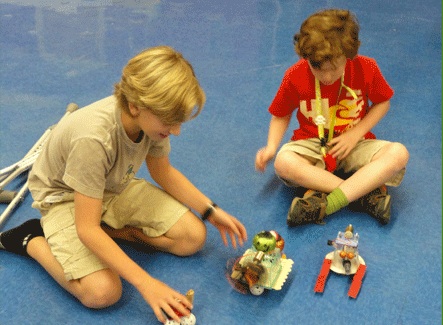
I just found out (thanks to this Makezine post) about a new children’s club called the Maker Scouts. From the Maker Scouts International website:
The Maker Scouts is a weekly scouting program for young children (4-10) who are ready and interested in Tinkering and Making with different materials and tools. The Maker Scouts program provides young Makers learning opportunities in STEAM [Science, Technology, Engineering, Art, and Math] education through four 12 week sessions, each of which focus on critical thinking, design, and building with hand-on activities.
Activities are designed to help the youngest makers become safe, proficient users of making tools and materials on their way to discovering their passion and language of self expression. The program also provides young people learning opportunities that foster the core values of the Innovator Mindset– embracing failure, frustration tolerance, communication, collaboration, creativity and empathy.
Like other scouting groups, Maker Scouts receive badges (which they can collect on their work aprons) for making skills, as well as demonstration of a very sensible and inclusive set of Core Values. Unlike some other scouting groups, Maker Scouts welcomes all interested children between the ages of 4-10. Their recent meeting of Maker Scouts Los Angeles attracted equal numbers of girls and boys, who built and played musical instruments. Other activities span a wide range of skills:
Maker Scouts MAKE robots, sew upcycled clothing , play with circuits, invent games, use e-textiles, build with wood, metal, plastic, make cardboard creations, play with food, tinker with real tools, shoot off rockets, invent real world solutions to real world problems and so much more.
For older kids, a sister organization called Hacker Scouts is available.
My hat is off to everyone involved in these organizations. STEM jobs are growing so fast that employers often can’t find people to fill them. And even kids who don’t grow up to work in a STEM career will benefit greatly from the critical thinking and problem-solving skills that STEM activities build. Working with kids can be challenging, but we owe it to them to give them every opportunity we can to stretch their minds and build stuff.
Maker Scouts is just getting started, so give some thought to how you can help them in your area!


 Bot Scene